
The economic data of the global economic powers have been deteriorating, entering the bear market stage of the economy, and people have become more cautious when choosing asset investment.
We should choose investment products with a low correlation coefficient with economic performance and investment products suitable for the current economic cycle. Investors should pay more attention to foreign exchange and commodity markets so that they can add value to your assets.
Among many assets, anti-inflation commodities such as gold have become essential assets.
Take gold as an example. For many years, gold has been regarded as an anti-inflation commodity by international capital markets and has been regarded as an important asset hedging tool by investors.
There is also a saying, "The world bought gold during turbulent times." From basic political theory, we know that gold is not currency, and the currency is naturally gold and silver.
Although gold has withdrawn from the market as a currency, its attributes as a currency still exist. The credit currency circulating in the market is based on the commitment of a country, and the currency itself is worthless.
In other words, the state promises to convert currency into commodities of corresponding value. Therefore, when a country experiences a credit crisis, it will trigger a currency crisis and the currency in circulation is likely to be worthless.
But gold is not based on national credit, it has high value itself, so it can survive the crisis.
With the risk aversion further heating up, gold is expected to continue to rise.
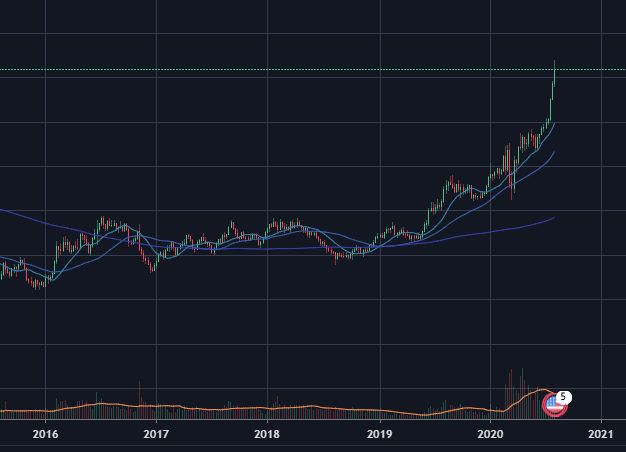 |
| Gold price weekly chart |
Through the following simple model of gold, The reasonable price of gold is more than $2,500.
Comments
Post a Comment